
Summary:
You’re paying for advertising that disappears the moment your contract ends. Billboards sit in one location. Radio spots air for thirty seconds and vanish. Print ads get tossed with yesterday’s news. Meanwhile, your work trucks drive through McHenry County, IL every single day—completely blank.
Here’s what most business owners don’t realize: those vehicles are already doing the work. They’re already out there. The question isn’t whether to advertise. It’s whether you’re going to use the mobile billboard you’re already paying for, or keep throwing money at channels that stop working the second you stop paying.
This isn’t about flashy marketing tactics. It’s about the actual numbers—cost per impression, daily reach, and what you’re really getting for your investment. Let’s break down how vehicle branding compares to traditional advertising, so you can see exactly where your marketing budget goes furthest.
What Is Vehicle Branding and How Does It Work
Vehicle branding turns your cars, trucks, or vans into mobile advertisements by applying custom vinyl graphics, wraps, or decals that display your company logo, contact information, and brand message. Think of it as taking the blank canvas of your work vehicle and transforming it into a rolling billboard that works for you 24/7.
The process is straightforward. Professional installers apply high-quality vinyl materials directly to your vehicle’s exterior surfaces. You can choose a full wrap that covers the entire vehicle, a partial wrap that highlights specific areas like doors and panels, or simple vinyl lettering for a clean, minimalist approach.
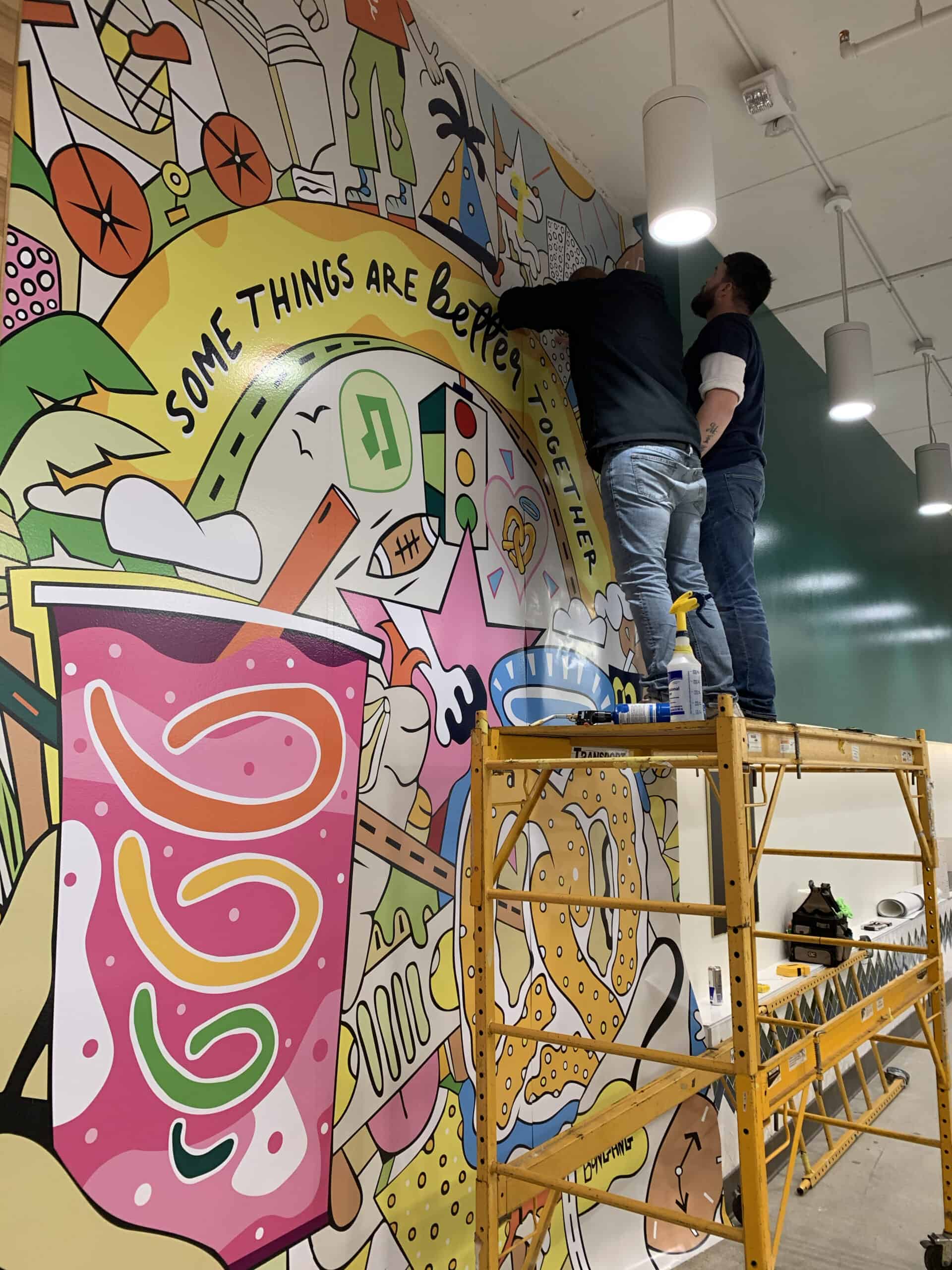
What makes this different from slapping a magnetic sign on your door is the quality, durability, and visual impact. Modern vehicle graphics use premium materials from manufacturers like 3M and Avery Dennison, designed to last 5-7 years with proper care. The installation is precise, the finish is professional, and the result is a mobile marketing tool that generates impressions every time your vehicle hits the road—or sits parked at a job site.
How Vehicle Wraps Generate Advertising Impressions

Every time your branded vehicle drives down a street, sits in traffic, or parks outside a client’s home, it’s creating impressions. An impression is simply someone seeing your brand message. The more people who see it, the more impressions you generate.
Here’s where the numbers get interesting. According to data from the Transportation Advertising Council and industry research, a single wrapped vehicle generates between 30,000 and 70,000 impressions per day depending on where you drive and how much ground you cover. That’s not a typo. We’re talking about tens of thousands of potential customers seeing your business name and services—every single day.
Compare that to a billboard. A billboard sits in one fixed location. Sure, it might get high traffic if you pay for a premium spot, but it’s stationary. Your vehicle goes everywhere you go. It drives through different neighborhoods. It parks at different job sites. It sits in your driveway, in parking lots, at the gas station, outside restaurants. Each location creates new exposure to different audiences.
The mobility is what makes vehicle branding so effective. You’re not limited to one geographic spot or one demographic. Your advertising moves with you, reaching diverse audiences across McHenry County, IL and beyond. Whether you’re heading to a job in Crystal Lake, stopping for supplies in Woodstock, or driving through Huntley, your brand is visible.
And here’s the part most business owners overlook: impressions happen even when you’re not actively working. Your vehicle parked outside your home generates impressions from neighbors. Parked at a client’s property, it generates impressions from everyone who drives or walks past. Sitting in a parking lot while you grab lunch creates more exposure. There’s no downtime. The advertising never stops.
Research from 3M and the Outdoor Advertising Association of America shows that vehicle graphics generate approximately 101 impressions per mile traveled. If your vehicle drives 100 miles in a day, that’s over 10,000 impressions from driving alone. Add in parked visibility, and those numbers climb significantly.
Types of Vehicle Branding Options and Their Costs
Not every business needs a full vehicle wrap, and that’s actually good news for your budget. Vehicle branding comes in several formats, each with different price points and visual impact. Understanding your options helps you choose the right fit for your goals and budget.
Full wraps cover your entire vehicle from bumper to bumper, including doors, hood, roof, and rear panels. This creates maximum visual impact and turns your vehicle into a complete mobile billboard. The investment typically ranges from $2,000 to $5,000 depending on vehicle size and design complexity. A full wrap on a cargo van costs more than a sedan simply because there’s more surface area to cover. But the trade-off is maximum visibility from every angle and complete brand consistency.
Partial wraps cover specific sections of your vehicle—usually the rear, sides, or hood. This approach costs less than a full wrap, typically running between $1,300 and $3,000, while still delivering strong visual presence. Many businesses use partial wraps strategically, focusing graphics on the most visible panels like rear doors or side panels that face traffic. You get professional branding at a lower price point, though with less coverage than a full wrap.
Vinyl lettering and decals offer the most budget-friendly entry into vehicle branding. These involve applying cut vinyl letters, logos, and graphics directly to your vehicle’s paint. Costs typically range from $500 to $1,500 depending on how much coverage you want. This works well for businesses that want a clean, professional look without the bold statement of a full wrap. Your company name, logo, and website can be clearly displayed without covering the entire vehicle.
The key difference between these options isn’t just cost—it’s exposure and impact. A full wrap creates maximum impressions because your branding is visible from every angle. Partial wraps work well when your vehicles are often seen from specific angles (like the rear in traffic). Vinyl lettering provides professional identification without the full advertising punch.
Material quality also affects cost and longevity. Premium cast vinyl from manufacturers like 3M costs more upfront but lasts longer and looks better throughout its lifespan. Calendered vinyl costs less but may not hold up as well on complex curves and may have a shorter outdoor life. We use high-quality materials because we know durability matters. A wrap that fades or peels after two years isn’t a good investment, no matter how cheap it was initially.
Installation quality is just as important as material choice. Professional installation by certified installers ensures your wrap looks flawless and lasts its full expected lifespan. Poor installation leads to bubbles, wrinkles, and premature failure. This is why working with experienced installers who have credentials from organizations like 3M, PDAA, and SGIA matters. We know how to properly prepare surfaces, apply materials, and finish edges so your investment performs as expected.
Traditional Advertising Costs and ROI Comparison
Traditional advertising—billboards, radio, print, and TV—has been the go-to for businesses for decades. These channels work. They reach audiences. But they come with a specific cost structure that many small business owners don’t fully calculate until they’re already committed.
The fundamental difference is this: traditional advertising operates on a recurring payment model. You pay for a time slot, a space, or a circulation period. When that period ends, so does your advertising. Your message disappears. To keep your brand visible, you keep paying. Month after month. Year after year.
Let’s look at the actual numbers. Billboard advertising in a market like Northern Illinois typically costs anywhere from $800 to $3,000 per month for a standard location. Premium locations near highways or high-traffic intersections can run $5,000 to $20,000 monthly. That’s rental cost alone—it doesn’t include design and production of the actual billboard creative, which can add another $500 to $2,000 depending on size and complexity.
Cost Per Impression: The Real Advertising Value Metric

When you’re evaluating advertising options, the metric that matters most is cost per thousand impressions, or CPM. This tells you exactly how much you’re paying to get your message in front of 1,000 people. Lower CPM means you’re getting more exposure for your money.
According to data from the Outdoor Advertising Association of America and industry research from 3M, vehicle wraps deliver a CPM between $0.15 and $0.77. That means for every thousand people who see your branded vehicle, you’re paying less than one dollar. Some studies show fleet graphics achieving CPM as low as $0.48—the lowest of any major advertising medium.
Now compare that to traditional channels. Billboard advertising averages $2.18 to $3.56 CPM. Radio advertising runs around $7.75 CPM. Newspaper ads cost approximately $19.70 CPM. Magazine advertising hits $21.46 CPM. Television advertising tops the list at $23.70 CPM. Every single one of these channels costs significantly more per impression than vehicle branding.
Here’s what that looks like in real dollars. If you want to generate 100,000 impressions with vehicle wraps at $0.48 CPM, you’re looking at $48. To generate the same 100,000 impressions with a billboard at $3.56 CPM costs $356. Radio at $7.75 CPM would cost $775. Newspaper at $19.70 CPM runs $1,970. The difference is massive.
But the real kicker is longevity. Those CPM costs for traditional advertising apply every single campaign period. Your billboard costs $356 per 100,000 impressions every month you rent that space. Your vehicle wrap costs are one-time. You pay once for the wrap installation, and then it generates impressions for 5-7 years without additional cost.
Let’s do the math on a five-year comparison. A vehicle wrap costs $3,000 installed. Over five years, if it generates 50,000 impressions per day (a conservative estimate), that’s 91,250,000 total impressions. Your cost per thousand impressions over that period is $0.03. A billboard generating the same impressions at $3.56 CPM would cost $324,850 over five years. The difference is staggering.
This is why vehicle branding delivers such exceptional ROI. You’re not just getting lower cost per impression—you’re getting it without recurring payments. The advertising keeps working long after you’ve paid for it. Traditional channels stop the moment your contract ends.
Message Recall and Advertising Effectiveness
Getting impressions is one thing. Having people actually remember your message is another. This is where vehicle branding shows a significant advantage over traditional advertising methods, particularly billboards.
Research conducted by RYP & Becker Group and reported in 3M’s mobile media advertising case studies found that 97% of people remember ads they see on vehicles. Compare that to traditional billboards, which achieve only 19% message recall. That’s a 78-point difference in how well your advertising sticks in people’s minds.
Why such a dramatic difference? Several factors come into play. First, vehicle graphics are unexpected and dynamic. A billboard sits in the same spot every day. People drive past it so often it becomes part of the scenery—they stop consciously seeing it. A branded vehicle, on the other hand, appears in different contexts. You see it at a job site one day, in traffic the next, parked at a restaurant the following week. Each encounter feels fresh because the context changes.
Second, vehicle branding is non-intrusive. Unlike TV commercials that interrupt your show, radio ads that break up your music, or pop-up ads that block your screen, vehicle graphics simply exist in your environment. You notice them naturally as part of your daily routine. This creates a more positive association. You’re not being forced to watch an ad—you’re simply seeing a business vehicle go about its work.
Third, there’s an authenticity factor. When you see a branded work truck, you’re seeing evidence that this business is active, working, serving customers in your area. It’s not just an ad claiming they’re local—it’s visual proof. That builds trust in a way that traditional advertising can’t match.
Industry data from the American Trucking Association shows that 75% of consumers form a favorable impression of a company based on its vehicle graphics. Even more compelling, 29% say vehicle graphics have directly influenced a buying decision. These aren’t passive impressions—they’re creating actual business results.
The non-intrusive nature of vehicle advertising also means people are more receptive to the message. A study found that 96% of audiences thought vehicle graphics had more impact than billboards. When people see your branded vehicle, they’re not trying to skip it, block it, or ignore it the way they do with interruptive advertising. They simply process the information naturally.
This higher recall rate and positive reception translates to better ROI. You’re not just getting seen—you’re being remembered. And you’re being remembered in a positive context that builds credibility and trust. For local businesses in McHenry County, IL, that local visibility and positive impression directly impacts whether someone calls you when they need your services.
Making the Right Advertising Investment for Your Business
The numbers don’t lie. Vehicle branding delivers lower cost per impression, higher message recall, and continuous exposure without recurring fees. Traditional advertising has its place, but for small businesses looking to maximize every marketing dollar, the math strongly favors vehicle graphics.
You’re already driving your vehicles every day. They’re already visible in your community. The only question is whether you’re going to use that visibility strategically or let it go to waste. A one-time investment in professional vehicle branding creates years of advertising value, reaching tens of thousands of potential customers without monthly bills or renewal fees.
If you’re ready to turn your vehicles into working marketing assets, we bring over 20 years of experience helping businesses in McHenry County, IL and throughout Northern Illinois create high-quality vehicle graphics that deliver results. Professional installation, premium materials, and a commitment to getting it right means your investment performs exactly as it should—generating impressions, building recognition, and bringing in business for years to come.